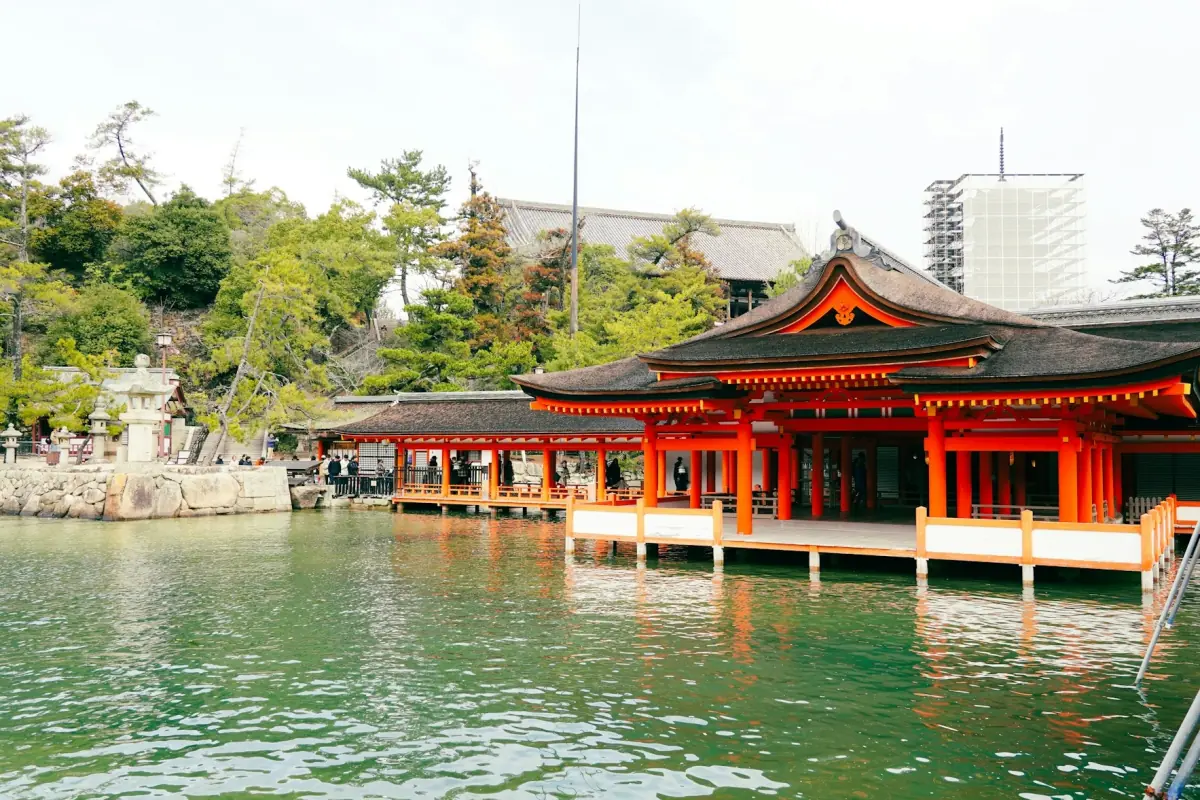
Itsukushima Shrine history in short
The shrine stands on Miyajima, an island long regarded as sacred in the Shinto faith. The halls are built over the shore, so at high tide they reach out over the sea. Tradition says the shrine was founded in 593 by Saeki no Kuramoto. That is the date handed down by the shrine, not the year of any building you see today.
The shrine you visit now is the result of later rebuilding. In 1168, Taira no Kiyomori had it rebuilt and enlarged in the Shinden style. The halls themselves are younger, and the Great Torii in the water dates from 1875. If you keep these years apart, the history of Itsukushima is easy to follow. To see it on the ground, a guided walk helps: have a look at our Miyajima tours.

Timeline: the key years at Itsukushima
Years for the shrine, its halls and the Great Torii. Keep the founding of the shrine apart from the age of single buildings.
| Year | What happened | What it means today |
|---|---|---|
| 593 | Founding by Saeki no Kuramoto, by tradition | Not the year of a surviving building |
| 1168 | Taira no Kiyomori has the shrine rebuilt and enlarged in the Shinden style | The present complex comes from later rebuilding |
| 1241 | Prayer and purification hall | Date given for this hall only |
| 1407 | Five-storey pagoda built | 27.6 m tall; under construction at present |
| 1571 | Present main hall | Date given for this building only |
| 1587 | Work begins on Senjokaku on the initiative of Hideyoshi | The hall was never finished |
| 1680 | Present Noh stage, rebuilt by Asano Tsunanaga | A cultural building, not a daily performance |
| 1875 | The present Great Torii is rebuilt | Not the founding year of the shrine |
| 1996 | UNESCO World Heritage inscription | Shrine ensembles and the forest around Mount Misen |
For most visitors, the practical lesson is this: you see a shrine that was rebuilt several times over the centuries, in the form of the later periods. The halls, the corridors, the Noh stage and the Torii each have their own dates.
Our pick: a tour with shrine and museum entry
Entry to Itsukushima Shrine and the museum in Hiroshima is included, so you follow the history with a guide.
Hand-picked tours, booked through Viator. Prices are indicative starting prices in US dollars (as of October 2026). Tap a tour for live availability and the current price in your currency.

Guided visits and tours on Miyajima
Walks with a guide, shrine visits and day trips from Hiroshima, with live prices and availability. Check what each option includes before you book.
A sacred island and three goddesses
The shrine is dedicated to three goddesses: Ichikishimahime-no-mikoto, Tagorihime-no-mikoto and Tagitsuhime-no-mikoto. UNESCO describes the island as a holy place of Shinto since early times. The architecture joins the sea, the buildings and the forested mountain behind them into one setting.
On site, what counts is what the shrine and the city ask of you: quiet, respect and care for the deer and the forest.
The halls, the pagoda and Senjokaku
The shrine halls and corridors stand on posts over the tidal flat. Gaps between the floor boards let the pressure of high water escape. Senjokaku, the large hall, was begun in 1587 and never completed. The five-storey pagoda dates from 1407. It is under construction at present and the work is expected to end between December 2026 and November 2027, so do not plan a photo of it.

The Great Torii: 1875 and the restoration of 2019 to 2022
The Great Torii you see today was rebuilt in 1875. It is 16.6 m high, has a roof 24.2 m wide and weighs about 60 tonnes. The main pillars are natural camphor trees, and the box at the top holds around 4 tonnes of pebbles. The gate stands on the ground by its own weight, on a base of driven pine piles. It is not floating. The impression comes from the water around a fixed structure.
A major restoration began in June 2019 and ended in December 2022. It is part of the history of the gate, not a closure you need to plan around today. For the details of the structure and the views, see the page on the Great Torii.
UNESCO World Heritage: what is protected
Itsukushima was inscribed as a World Heritage Site in 1996 under the name Itsukushima Shinto Shrine, with the criteria (i), (ii), (iv) and (vi). The core zone covers 431.2 hectares and the buffer zone 2,634.3 hectares. The protection covers the shrine ensembles and the forest around Mount Misen. It does not make the whole island a core World Heritage area.
In 1952 the whole island became part of the Setonaikai National Park. Special rules apply by area, so they are not identical on every street and beach. The Atomic Bomb Dome in Hiroshima is a separate World Heritage Site, also inscribed in 1996. It is a separate inscription from the shrine's.
What you can see today
- Shrine and corridors: the route runs through the east corridor, the main shrine, the platforms and the west corridor. The east corridor is being strengthened until December 2026. This is not a full closure of the shrine.
- Great Torii: best seen at high tide in the water or at low tide on the sand. Use the tide times to choose the hour.
- Senjokaku: open from 08:30 to 16:30. Adults and high school students pay 100 yen, elementary and middle school students 50 yen (2026).
- Shrine entry: 300 yen for adults in 2026. The tickets and visitor tax page has all fares.
Keep exploring Miyajima
Pages that connect the history with a visit.

Itsukushima Shrine on Miyajima
Opening hours, the visitor route, corridors and festivals.

The Great Torii of Miyajima
Size, materials and the views at high and low tide.

Shrine tickets and the visitor tax
Entry fees in yen, combination tickets and the 100 yen visitor tax.

Things to do in Miyajima
Omotesando, Momijidani, deer and more places on the island.
Itsukushima Shrine history: questions
When was Itsukushima Shrine founded?
Tradition gives 593, the year Saeki no Kuramoto is said to have founded it. This is not the year of any building you can see today.
Who built the present shrine?
In 1168, Taira no Kiyomori had the shrine rebuilt and enlarged. The present complex is the result of later rebuilding. For example, the prayer and purification hall dates from 1241 and the main hall from 1571.
How old is the Great Torii?
The present Great Torii was rebuilt in 1875. A restoration ran from June 2019 to December 2022.
Which goddesses are worshipped at the shrine?
Three goddesses: Ichikishimahime-no-mikoto, Tagorihime-no-mikoto and Tagitsuhime-no-mikoto.
When did Itsukushima become a World Heritage Site?
In 1996. The core zone covers 431.2 hectares and the buffer zone 2,634.3 hectares.
When was the present Noh stage built?
The present Noh stage dates from 1680, when Asano Tsunanaga had it rebuilt. It is a cultural building, not the site of daily performances.