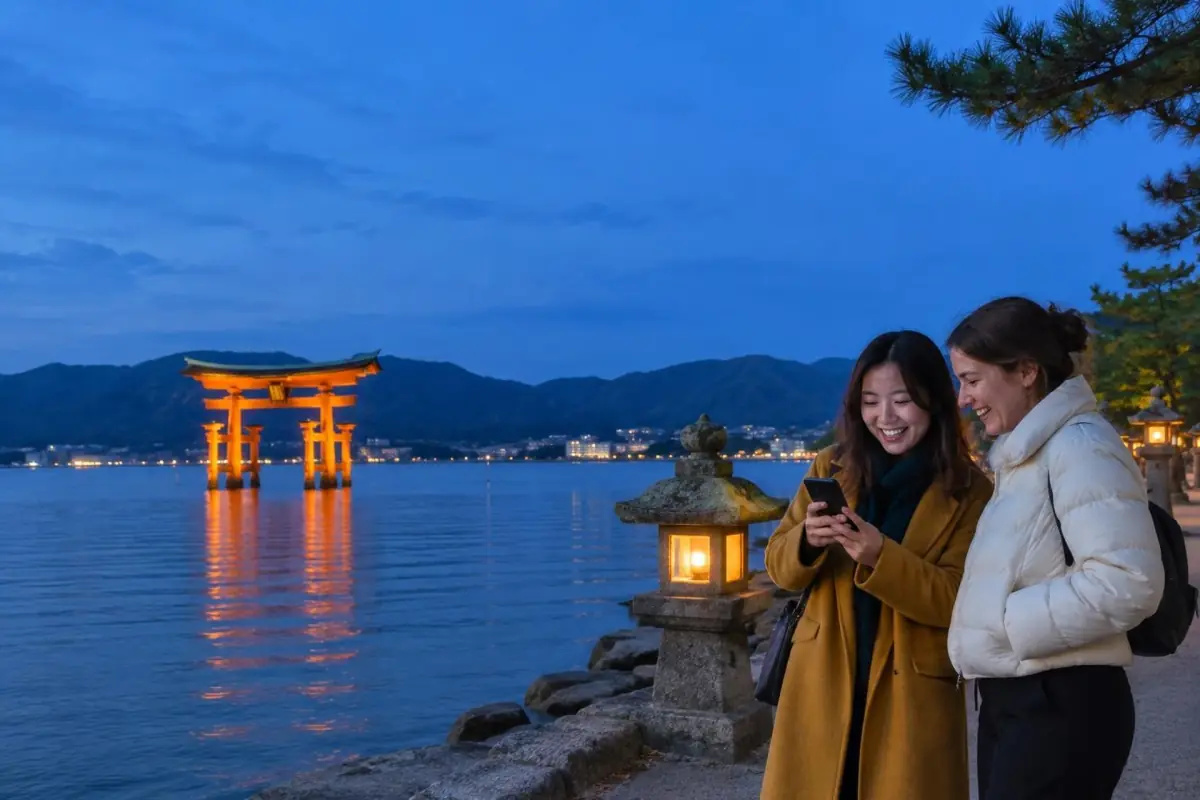
The Miyajima torii in numbers
The Miyajima torii is the red gate that marks the sea approach to Itsukushima Shrine. Its full name is Otorii, the Great Torii. The gate stands in the bay a short distance from the shore, so your view of it changes with the water. If you want a guide to explain it on site, compare the Miyajima tours before you travel.
The gate is a Ryobu torii. Two main pillars carry the roof, and smaller supports stand at their sides. The measurements below are the ones to keep in mind when you look at it from the shore.

Our pick: a tour with the great torii
A small-group half day from Hiroshima Station that combines Daisho-in with a visit to the great torii.
Hand-picked tours, booked through GetYourGuide. Prices are indicative starting prices in US dollars (as of October 2026). Tap a tour for live availability and the current price in your currency.

Miyajima tours that visit the Great Torii
Guided walks and island tours, with live prices and availability. Check in each listing what is included and whether it matches the tide on your day.
Why the torii looks like a floating gate
The gate does not float. It stands on the seabed, and the look comes from the water around it.
The "floating torii gate" effect appears when the water is high. A tide level above 250 cm on the Hiroshima Port table gives the floating impression of the shrine and the gate. When the level is under 100 cm, you can walk up to the gate over the sand. The table is for Hiroshima Port, and the tide at Itsukushima can come a little earlier. A centimeter value is a table level, not the depth of water at your feet.
Low tide alone does not promise a dry walk, so look at the table for your day. The tide times page explains how to read it.

High tide and low tide compared
What you can expect at each level on the Hiroshima Port table.
| Level | What you see | What it means for your visit |
|---|---|---|
| Under 100 cm | Wet sand around the gate | You can walk out to the pillars |
| 100 to 250 cm | Water around the base of the gate | Look at the table for the exact hour |
| Over 250 cm | The gate and the shrine look as if they float | Good for photos from the shore and the corridors |
For most visitors, the better plan is to see the gate twice: once from the shrine at high water and once on foot at low water. If you have only one visit, decide first which view you want and choose the hour from the table. Lake Ashi in Hakone has a torii of its own rising from the water beside Hakone Shrine.
How the Great Torii is built
Wood, weight and a prepared seabed.
Materials
The two main pillars are natural camphor trees, and the supports around them are cedar (sugi). The circumference of a main pillar is 9.9 m.
The weight in the roof
The hollow box at the top holds about 4 t of pebbles. This adds to the weight that keeps the gate upright.
The seabed
The pillars stand on the ground without being buried. Pine piles driven into the seabed underneath keep the ground firm. The gate holds itself up by its own weight, on a prepared base.
The present gate
The gate was rebuilt in 1875. It is not the date of the shrine, which is much older. See the history page.
Restoration
A major restoration ran from June 2019 to December 2022. The gate is no longer under scaffolding.
Seeing the torii from the shore, the shrine and the water
Four ways to look at it, and one rule for the evening.
From the shore
The shore walk near the shrine gives a clear view at any tide. At low water you can walk out. At high water, stay on the shore.
From the shrine corridors
The route through Itsukushima Shrine frames the gate from the corridors. The view depends on the tide.
From a ferry
A ferry loop past the torii leaves Miyajimaguchi between 9:10 and 16:10. It may not run when the tide does not allow it.
From the water
Sea kayaks and small boats are also seen near the gate. Read the kayaking page before you plan one.
After dark
The torii and shrine buildings are lit from 30 minutes after sunset until 23:00. Rituals and events can change this. The shrine itself is normally closed to visitors while the lights are on.
Continue your visit
Tides, shrine and history next.


Great Torii questions
How tall is the Great Torii?
It is 16.6 m tall, with a roof ridge of 24.2 m and a total weight of about 60 t.
Does the torii really float?
No. It stands on the seabed. The floating look comes from high water around a gate that is fixed in place.
When can I walk to the Great Torii?
Around low water, when the level is under 100 cm on the Hiroshima Port table. Look up the table for your day and add a safety margin for the return.
Is the torii still under restoration?
No. The restoration ran from June 2019 to December 2022.
Can I see the torii lit at night?
Yes, in general. The lighting runs from 30 minutes after sunset until 23:00 all year, with exceptions for rituals and events. Note that the last regular ferry from the island leaves earlier. See the ferry page.